Tag: Cat behavior

  • Litter Box Management in a 10-Cat Household

    Litter Box Management in a 10-Cat Household

    With 10 cats, you can imagine we go through a lot of cat litter.

    I’d like to thank Chewy for free shipping.

    And the poor FedEx driver who has the misfortune of delivering to us.

    All 160 pounds of litter. Every month.

    Over the years, we’ve developed some litter box standards around here.

    Our House Rules for Litter Boxes

    Any room a cat could accidentally get locked in must have a litter box.

    Cats aren’t spiteful. They aren’t plotting revenge because you dared to go on vacation for three days.

    Most of the time, if a cat suddenly stops using the litter box, there’s a reason.

    One of those reasons is simply not having access to a box when they need one.

    If someone accidentally closes a door, we don’t want a cat forced to choose between “hold it” and “find another option.”

    We set them up for success by making sure a litter box is always available.

    In our house, we also installed cat doors so the cats can’t accidentally become trapped without access to a box.

    (Those cat doors will absolutely become a future product review.)

    Litter boxes go in rooms where people go.

    The living room? Yes.

    The bathroom? Yes.

    The office? Yes.

    A bedroom? Yes.

    The kitchen?

    Eew. No.

    Cats don’t love using litter boxes hidden away in dark, isolated corners of the house. Going to the bathroom is one of the times they feel most vulnerable.

    A conveniently located box is much more likely to get used than one hidden in the farthest corner of the basement.

    Litter boxes must have high sides.

    If you’ve never lived with male cats, allow me to introduce you to one of life’s less glamorous surprises.

    Some boys don’t squat particularly well.

    Instead, they stand a little taller and pee a little higher than you would prefer.

    High-sided boxes help keep the litter inside the box and the urine where it belongs.

    Your floors will thank you.

    Litter boxes are scooped as needed.

    Sometimes that’s once a day.

    Sometimes it’s multiple times a day.

    Sometimes it’s ten minutes after you just finished scooping.

    No one wants to use a dirty toilet.

    Your cat doesn’t either.

    With seven litter boxes serving ten cats, scooping frequently is simply part of life around here.

    What Our Setup Actually Looks Like

    Despite the official recommendation of one litter box per cat plus one extra, we currently maintain seven extra-large litter boxes.

    Four are located inside the house:

    • Living room
    • Bathroom
    • Home office
    • Bedroom

    The remaining three are technically in the garage.

    Before you picture cats weaving between parked cars, the garage setup deserves some explanation.

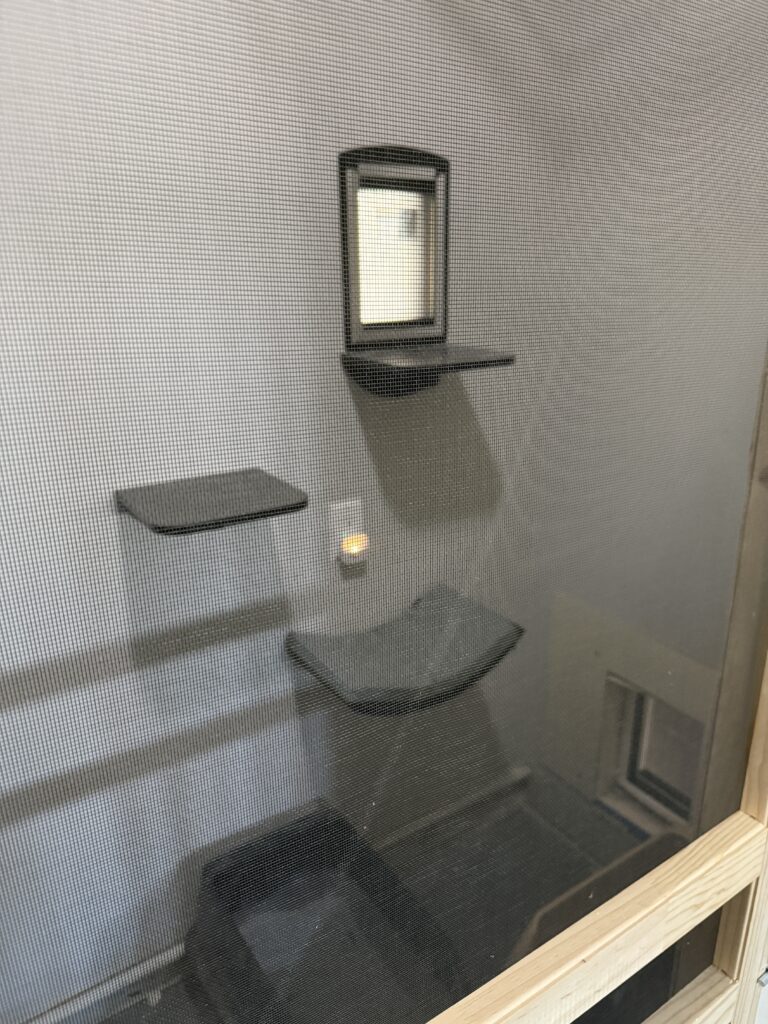
    Two cat doors lead directly through the walls of the house into a framed, screened section of the garage dedicated entirely to litter boxes. The cats have constant access, while the humans maintain the illusion that we have some separation between our living space and seven giant toilets.

    It works surprisingly well.

    Mostly.

    As long as Chewy keeps delivering 160 pounds of litter every month.
  • Litter Boxes 101: What Every Cat Owner Should Know

    Litter Boxes 101: What Every Cat Owner Should Know

    Presented by Comet

    One of the best things about cats is that, unlike dogs, they generally come pre-programmed with the desire to use a bathroom in an appropriate location.

    If you’ve ever spent months housebreaking a puppy while standing outside in the rain at 2 a.m., this feels like magic.

    No Training Required

    For those new to cat ownership, you should know that litter training a cat is nowhere near as challenging as housebreaking a dog.

    When kittens are big enough to walk on their own and can climb over the edge of the litter box, you basically just show them where the litter is and let them go. They’ll figure it out from there.

    Digging and burying waste is a natural cat behavior. Your job is simply to provide an appropriate place for them to do it.

    If a kitten seems confused, placing them in the litter box a few times can help them connect the dots. Most of the time, though, they need remarkably little instruction.

    How Many Litter Boxes Do You Need?

    The official recommendation is the number of cats you have, plus one extra.

    One cat? Two boxes.

    Two cats? Three boxes.

    Ten cats?

    Please don’t do that math right now.

    Like most cat advice, this recommendation exists for a reason. Some cats prefer one box for urinating and another for bowel movements. Some don’t like sharing. Some cats are just dramatic.

    The goal is to ensure that every cat always has access to a clean, acceptable bathroom option.

    That doesn’t necessarily mean every household has to follow the formula exactly. Factors like box size, the layout of your home, how frequently you scoop, and your cats’ personalities all play a role.

    But if you’re struggling with litter box issues, increasing the number of boxes is often a good place to start.

    Bigger Is Usually Better

    Many commercial litter boxes are surprisingly small.

    Most cats prefer a box that allows them to comfortably turn around, dig, and bury their waste without feeling cramped.

    As a general rule, the box should be at least one and a half times the length of your cat.

    And if you have a cat who somehow manages to pee over the side of the box despite having access to the entire interior space, high-sided boxes may save both your sanity and your flooring.

    Especially if you have boys.

    Boy cats can be… enthusiastic.

    Location Matters

    Imagine if the only bathroom available to you was in the basement, behind the washing machine, with a vacuum cleaner randomly turning on throughout the day.

    You’d probably hold it longer than you should.

    Cats feel vulnerable when using the litter box. They generally prefer areas that offer a bit of privacy without being completely isolated from the rest of the household.

    Avoid placing litter boxes right next to loud appliances or in areas that become inaccessible when doors are closed.

    And, as tempting as it is to hide every litter box in the most remote corner of your home, remember that convenience matters. If the litter box is difficult to get to, some cats may decide that the nearby rug is a better option.

    You will not agree with this decision.

    Scoop the Box

    No one wants to use a dirty toilet.

    Your cat doesn’t either.

    The frequency with which you need to scoop depends on how many cats are using the box, but daily scooping should be the minimum goal.

    More frequently is often better.

    Keeping boxes clean not only encourages appropriate litter box use, but also allows you to notice changes in your cat’s bathroom habits. Changes in urine volume, stool consistency, or frequency can sometimes be the first sign that something isn’t quite right.

    When Litter Box Habits Change

    One of the biggest misconceptions about cats is that they suddenly decide to become “bad.”

    Cats don’t usually stop using the litter box out of spite.

    If a cat that has reliably used the litter box for years suddenly starts having accidents, it’s worth paying attention.

    Medical conditions, stress, arthritis, environmental changes, bullying from another cat, or dissatisfaction with the litter box setup can all contribute.

    If litter box issues appear out of nowhere, a veterinary visit should be high on your list of next steps.

    Because while cats can’t tell us what’s wrong, they are often very good at showing us.

    Sometimes that message just arrives in the form of pee where it shouldn’t be.

  • The Cat is a Hat…

    The Cat is a Hat…

    And Other Callie-isms

    In the cat world, grooming is important.

    In Callie’s world, grooming is everything.

    Allogrooming, a social grooming behavior between members of the same species, is very common in cats. Grooming can be a sign of affection.

    Or a sign of dominance.

    For Callie, the species designation is not particularly important. This social grooming behavior applies to her chosen human as well.

    Does she love him?

    Or does she just want to outrank him?

    We choose to believe it’s a sign of love.

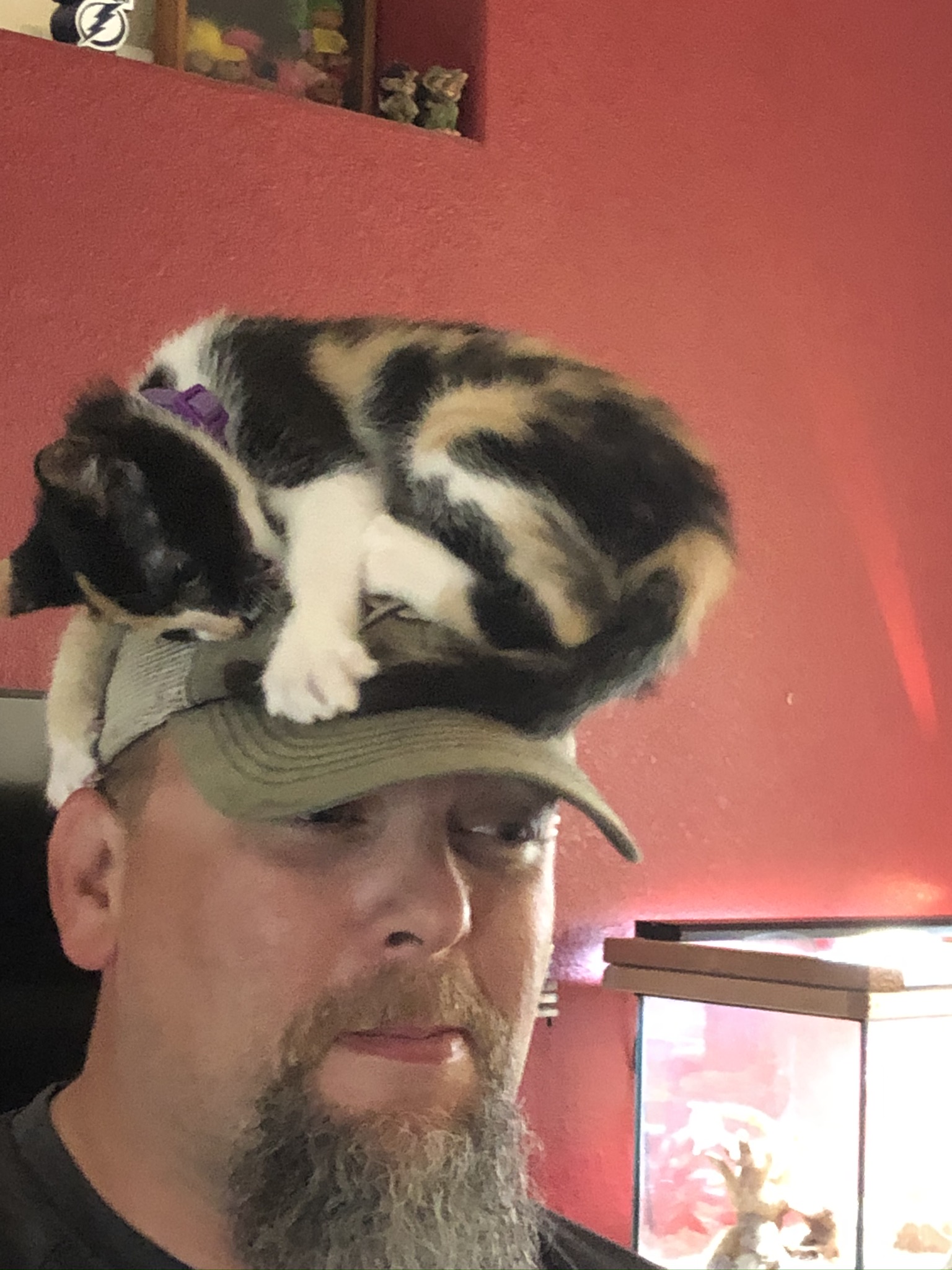
    Here she is, grooming her Daddy from her perch.

    On his head.

    This is not a one-time event. Given the choice, she will happily perch on his hat. Or directly on his head. It’s a little harder now than it was when she was a kitten—there’s simply more of her these days—but she still tries.

    And succeeds more often than you’d expect.

    The princess needs her bath

    Callie also expects Dad to reciprocate this grooming arrangement.

    She enjoys bath time.

    Not actual baths, mind you. That would be ridiculous.

    Instead, she stands on the edge of the bathroom sink and screams until Dad arrives to supervise her spa treatment.

    Sometimes she waits patiently.

    Sometimes she sits in the sink.

    As it fills with water.

    Because apparently this is normal behavior for a cat.

    We’ve stopped questioning it.

    At this point, we’ve accepted that Callie has her own set of rules. Dad is responsible for grooming. Callie is responsible for grooming Dad. Running water is required for proper bathing procedures.

    And baseball caps are simply elevated grooming stations.

    We’re not entirely sure whether she’s expressing affection or asserting authority.

    Either way, Dad has accepted his fate.

  • The Official House Rules of Claws & Disorder

    The Official House Rules of Claws & Disorder

    As Explained by Cleo

    Have you ever watched NCIS and seen Gibbs’ rules?

    Well, apparently our cats have rules too.

    And unlike Gibbs, they enforce them loudly.

    Rule #1: The house belongs to the cats.

    • When any rule is in doubt, refer to this rule.
    • We are not homeowners. We are support staff with a mortgage.

    Rule #2: Closed doors that are not made of glass are prohibited.

    A collection of cats in front of a closed door.

    The cats do not believe in privacy.

    Violations will immediately result in one or more of the following:

    • Pumpkin or Pie screaming dramatically from opposite sides of the door.
    • Tiny murder mittens pawing at or under the door.
    • Figaro suddenly deciding he urgently needs to be on the other side of the door.

    Once the door is opened, however, Figaro will often forget why he wanted through it in the first place.

    Rule #3: Closed doors made of glass are also prohibited.

    The transparency does not improve the situation.

    • Figaro finds glass barriers emotionally devastating.
    • Sliding glass doors and shower doors are considered deeply offensive.
    • Mournful crying will continue until the barrier is removed.

    You have been warned.

    Rule #4: If it might be food, it will be investigated.

    Bug takes food safety very seriously.

    • He always knows when someone is eating.
    • He always knows where the food is located.
    • He would like to formally inspect your ice cream.

    This inspection is not optional.

    Rule #5: Electronics may not be used when a cat requires attention.

    Cats believe screens exist solely to interfere with petting.

    • Cat paws work surprisingly well on touchscreens.
    • Laptops become significantly less functional with a cat standing on the keyboard.
    • Failure to provide adequate attention may result in hand swipes, aggressive headbutts, or a cat physically inserting themselves between you and the screen.

    Rule #6: Mom and Dad must be chaperoned at all times.

    The cats believe unsupervised human interaction is suspicious.

    • Romeo will position himself directly between Mom and Dad on the couch.
    • Callie lies across Dad’s chest at bedtime to prevent unauthorized rolling toward Mom.
    • Comet immediately claims his “prince pillow” beside Mom and pins at least one arm in place to restrict movement.

    The chaperone policy is strictly enforced.

    Rule #7: Sleeping cats may not be moved.

    If a cat chooses you as a bed, you are legally required to remain in place until further notice.

    • Shifting position is strongly discouraged.
    • Disturbing the cat may result in judgment, complaints, or immediate abandonment.
    • “Purralysis” can only be cured when the cat decides the cuddle session has concluded.

    Human discomfort is not considered relevant.

    Rule #8: “Kitty glitter” is a glamorous accessory.

    The cats work tirelessly to ensure their fur is included in every aspect of your life.

    • Sticky rollers are merely a temporary suggestion.
    • Black clothing is considered a personal challenge.
    • Cat hair will somehow appear on brand new clothes before they even enter the house.

    Resistance is futile. Acceptance is easier.

    Rule #9: Any visible portion of the food bowl means the bowl is empty.

    If even a single section of the bottom of the bowl is visible, the cats are clearly starving.

    • This remains true even when multiple full bowls are sitting directly beside it.
    • Food touching the edges instead of the center is apparently unacceptable.
    • Failure to immediately refill the bowl will be treated as evidence that the cats are unloved and abandoned.

    Complaints will be filed loudly and without delay.

    Rule #10: Visitors are expected to like cats.

    This is the cats’ house. Visitors are merely temporary guests.

    • Anyone claiming to “not be a cat person” will immediately be assigned a cat.
    • Allergies will be addressed through exposure therapy, antihistamines, or acceptance.
    • If someone in the house is uncomfortable, the visitors are the ones expected to leave.

    The cats live here. Everyone else is on probation.

    Including us.

    We may pay the mortgage and buy the food, but our role is clear.

    We are their servants.

    This is their house.

    They allow us to live here.