Author: Cat Mom

  • Litter Box Management in a 10-Cat Household

    Litter Box Management in a 10-Cat Household

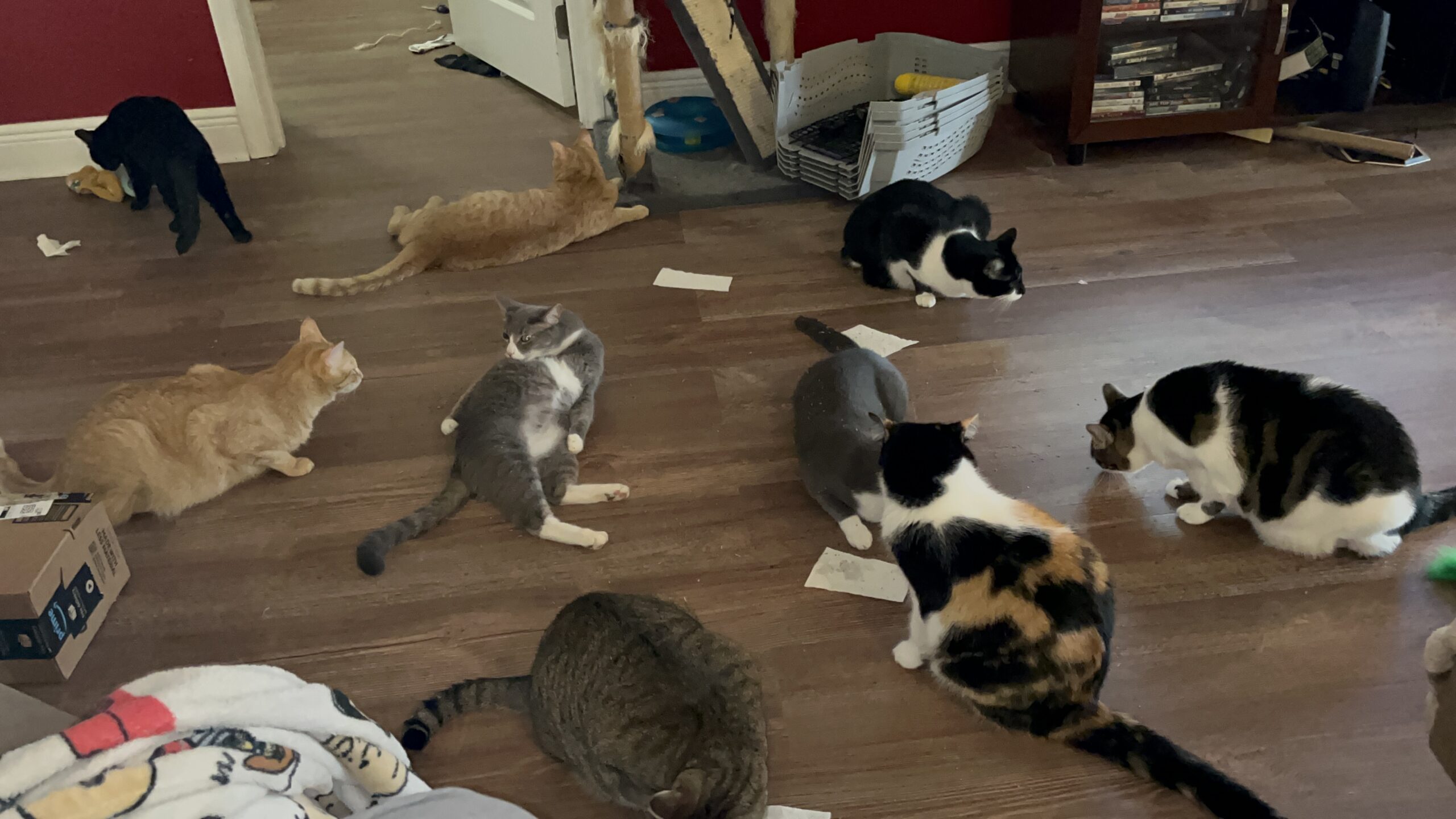
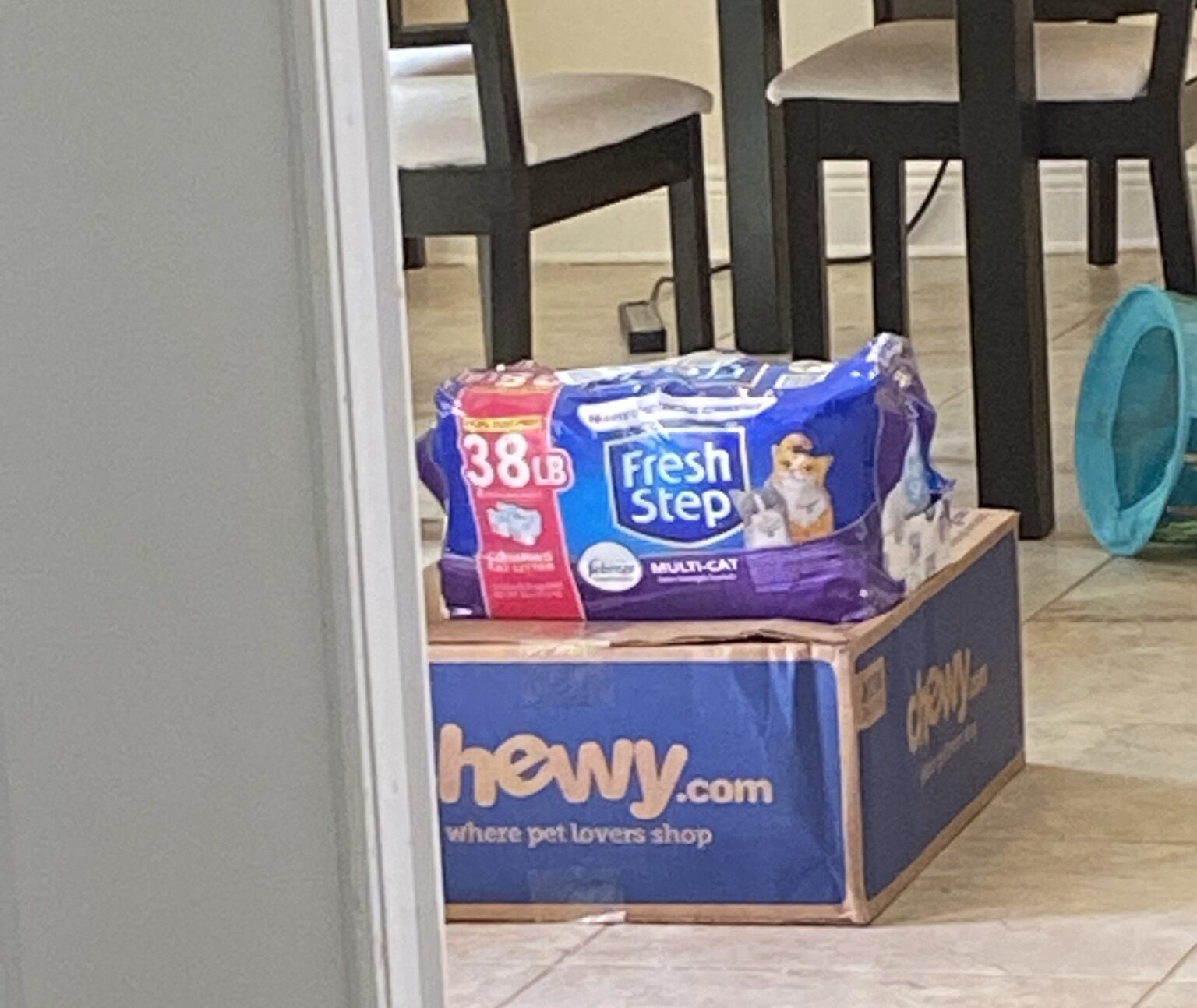
    With 10 cats, you can imagine we go through a lot of cat litter.

    I’d like to thank Chewy for free shipping.

    And the poor FedEx driver who has the misfortune of delivering to us.

    All 160 pounds of litter. Every month.

    Over the years, we’ve developed some litter box standards around here.

    Our House Rules for Litter Boxes

    Any room a cat could accidentally get locked in must have a litter box.

    Cats aren’t spiteful. They aren’t plotting revenge because you dared to go on vacation for three days.

    Most of the time, if a cat suddenly stops using the litter box, there’s a reason.

    One of those reasons is simply not having access to a box when they need one.

    If someone accidentally closes a door, we don’t want a cat forced to choose between “hold it” and “find another option.”

    We set them up for success by making sure a litter box is always available.

    In our house, we also installed cat doors so the cats can’t accidentally become trapped without access to a box.

    (Those cat doors will absolutely become a future product review.)

    Litter boxes go in rooms where people go.

    The living room? Yes.

    The bathroom? Yes.

    The office? Yes.

    A bedroom? Yes.

    The kitchen?

    Eew. No.

    Cats don’t love using litter boxes hidden away in dark, isolated corners of the house. Going to the bathroom is one of the times they feel most vulnerable.

    A conveniently located box is much more likely to get used than one hidden in the farthest corner of the basement.

    Litter boxes must have high sides.

    If you’ve never lived with male cats, allow me to introduce you to one of life’s less glamorous surprises.

    Some boys don’t squat particularly well.

    Instead, they stand a little taller and pee a little higher than you would prefer.

    High-sided boxes help keep the litter inside the box and the urine where it belongs.

    Your floors will thank you.

    Litter boxes are scooped as needed.

    Sometimes that’s once a day.

    Sometimes it’s multiple times a day.

    Sometimes it’s ten minutes after you just finished scooping.

    No one wants to use a dirty toilet.

    Your cat doesn’t either.

    With seven litter boxes serving ten cats, scooping frequently is simply part of life around here.

    What Our Setup Actually Looks Like

    Despite the official recommendation of one litter box per cat plus one extra, we currently maintain seven extra-large litter boxes.

    Four are located inside the house:

    • Living room
    • Bathroom
    • Home office
    • Bedroom

    The remaining three are technically in the garage.

    Before you picture cats weaving between parked cars, the garage setup deserves some explanation.

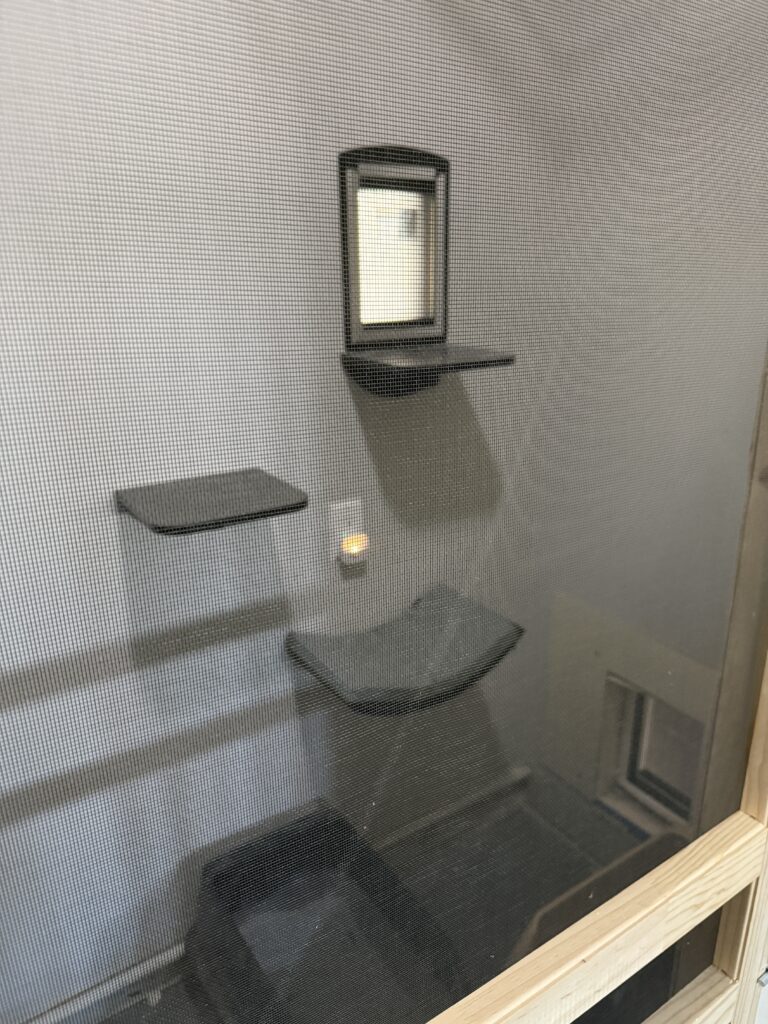
    Two cat doors lead directly through the walls of the house into a framed, screened section of the garage dedicated entirely to litter boxes. The cats have constant access, while the humans maintain the illusion that we have some separation between our living space and seven giant toilets.

    It works surprisingly well.

    Mostly.

    As long as Chewy keeps delivering 160 pounds of litter every month.

  • Litter Boxes 101: What Every Cat Owner Should Know

    Litter Boxes 101: What Every Cat Owner Should Know

    Presented by Comet

    One of the best things about cats is that, unlike dogs, they generally come pre-programmed with the desire to use a bathroom in an appropriate location.

    If you’ve ever spent months housebreaking a puppy while standing outside in the rain at 2 a.m., this feels like magic.

    No Training Required

    For those new to cat ownership, you should know that litter training a cat is nowhere near as challenging as housebreaking a dog.

    When kittens are big enough to walk on their own and can climb over the edge of the litter box, you basically just show them where the litter is and let them go. They’ll figure it out from there.

    Digging and burying waste is a natural cat behavior. Your job is simply to provide an appropriate place for them to do it.

    If a kitten seems confused, placing them in the litter box a few times can help them connect the dots. Most of the time, though, they need remarkably little instruction.

    How Many Litter Boxes Do You Need?

    The official recommendation is the number of cats you have, plus one extra.

    One cat? Two boxes.

    Two cats? Three boxes.

    Ten cats?

    Please don’t do that math right now.

    Like most cat advice, this recommendation exists for a reason. Some cats prefer one box for urinating and another for bowel movements. Some don’t like sharing. Some cats are just dramatic.

    The goal is to ensure that every cat always has access to a clean, acceptable bathroom option.

    That doesn’t necessarily mean every household has to follow the formula exactly. Factors like box size, the layout of your home, how frequently you scoop, and your cats’ personalities all play a role.

    But if you’re struggling with litter box issues, increasing the number of boxes is often a good place to start.

    Bigger Is Usually Better

    Many commercial litter boxes are surprisingly small.

    Most cats prefer a box that allows them to comfortably turn around, dig, and bury their waste without feeling cramped.

    As a general rule, the box should be at least one and a half times the length of your cat.

    And if you have a cat who somehow manages to pee over the side of the box despite having access to the entire interior space, high-sided boxes may save both your sanity and your flooring.

    Especially if you have boys.

    Boy cats can be… enthusiastic.

    Location Matters

    Imagine if the only bathroom available to you was in the basement, behind the washing machine, with a vacuum cleaner randomly turning on throughout the day.

    You’d probably hold it longer than you should.

    Cats feel vulnerable when using the litter box. They generally prefer areas that offer a bit of privacy without being completely isolated from the rest of the household.

    Avoid placing litter boxes right next to loud appliances or in areas that become inaccessible when doors are closed.

    And, as tempting as it is to hide every litter box in the most remote corner of your home, remember that convenience matters. If the litter box is difficult to get to, some cats may decide that the nearby rug is a better option.

    You will not agree with this decision.

    Scoop the Box

    No one wants to use a dirty toilet.

    Your cat doesn’t either.

    The frequency with which you need to scoop depends on how many cats are using the box, but daily scooping should be the minimum goal.

    More frequently is often better.

    Keeping boxes clean not only encourages appropriate litter box use, but also allows you to notice changes in your cat’s bathroom habits. Changes in urine volume, stool consistency, or frequency can sometimes be the first sign that something isn’t quite right.

    When Litter Box Habits Change

    One of the biggest misconceptions about cats is that they suddenly decide to become “bad.”

    Cats don’t usually stop using the litter box out of spite.

    If a cat that has reliably used the litter box for years suddenly starts having accidents, it’s worth paying attention.

    Medical conditions, stress, arthritis, environmental changes, bullying from another cat, or dissatisfaction with the litter box setup can all contribute.

    If litter box issues appear out of nowhere, a veterinary visit should be high on your list of next steps.

    Because while cats can’t tell us what’s wrong, they are often very good at showing us.

    Sometimes that message just arrives in the form of pee where it shouldn’t be.

  • The Cat is a Hat…

    The Cat is a Hat…

    And Other Callie-isms

    In the cat world, grooming is important.

    In Callie’s world, grooming is everything.

    Allogrooming, a social grooming behavior between members of the same species, is very common in cats. Grooming can be a sign of affection.

    Or a sign of dominance.

    For Callie, the species designation is not particularly important. This social grooming behavior applies to her chosen human as well.

    Does she love him?

    Or does she just want to outrank him?

    We choose to believe it’s a sign of love.

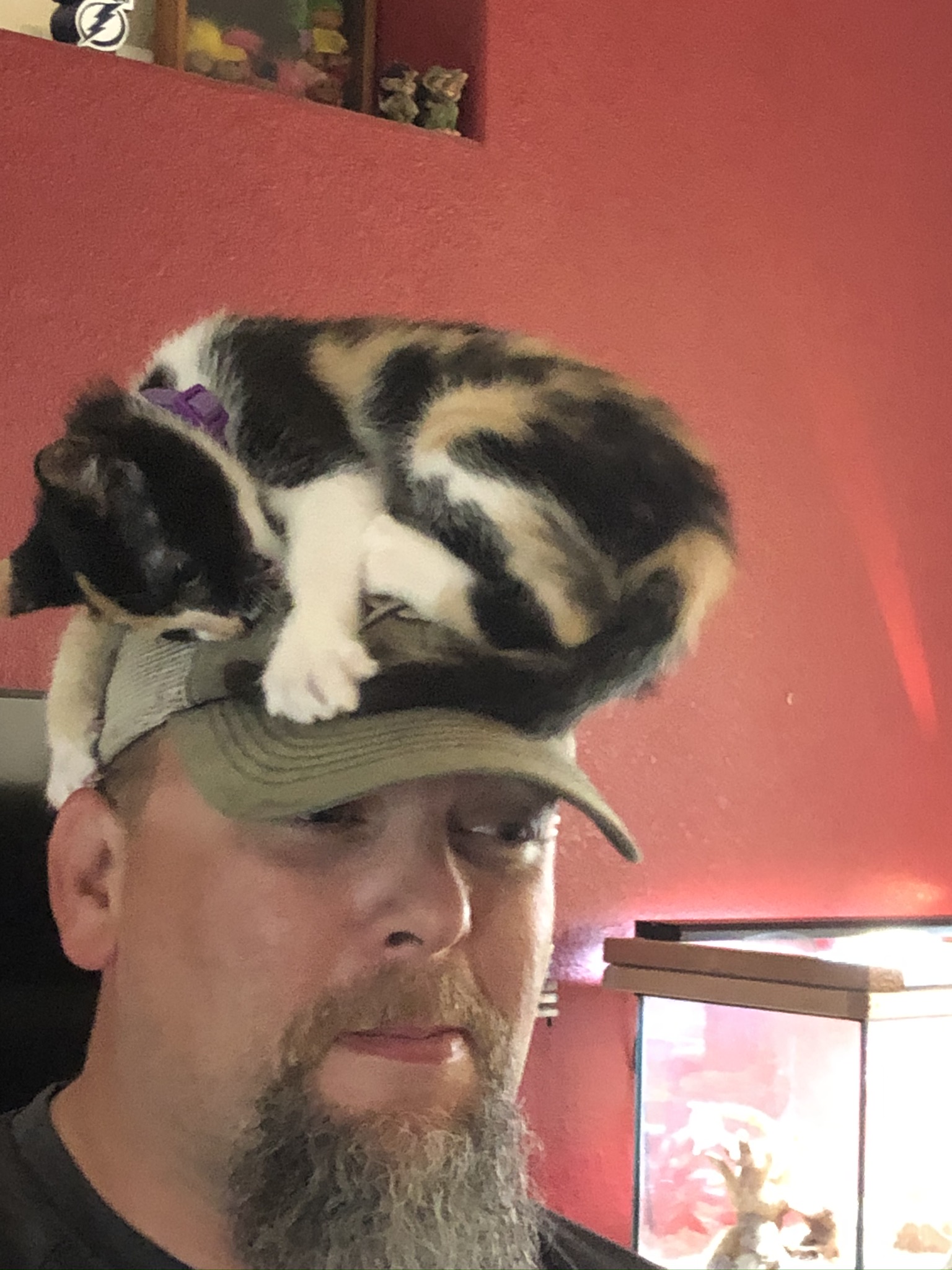
    Here she is, grooming her Daddy from her perch.

    On his head.

    This is not a one-time event. Given the choice, she will happily perch on his hat. Or directly on his head. It’s a little harder now than it was when she was a kitten—there’s simply more of her these days—but she still tries.

    And succeeds more often than you’d expect.

    The princess needs her bath

    Callie also expects Dad to reciprocate this grooming arrangement.

    She enjoys bath time.

    Not actual baths, mind you. That would be ridiculous.

    Instead, she stands on the edge of the bathroom sink and screams until Dad arrives to supervise her spa treatment.

    Sometimes she waits patiently.

    Sometimes she sits in the sink.

    As it fills with water.

    Because apparently this is normal behavior for a cat.

    We’ve stopped questioning it.

    At this point, we’ve accepted that Callie has her own set of rules. Dad is responsible for grooming. Callie is responsible for grooming Dad. Running water is required for proper bathing procedures.

    And baseball caps are simply elevated grooming stations.

    We’re not entirely sure whether she’s expressing affection or asserting authority.

    Either way, Dad has accepted his fate.

  • I’m Taller Than You!

    I’m Taller Than You!

    It sounds like a taunt between children, and it’s what I imagine Smokey would say any time he gets the chance.

    If Smokey can find an opportunity to be the tallest thing in the room, he will invariably take it.

    On ladders.

    On shower curtain rods.

    And sometimes, on screens.

    When Smokey was about a year old, he discovered that he could jump — and stick the landing — on the curtain rod above the bathtub or the metal frame of the shower doors. Once he learned this skill, there was no going back.

    Smokey, a grey and white cat, on top of a shower curtain rod.

    If you’ve never seen a cat flying toward you while you’re naked and vulnerable, well, you just haven’t lived.

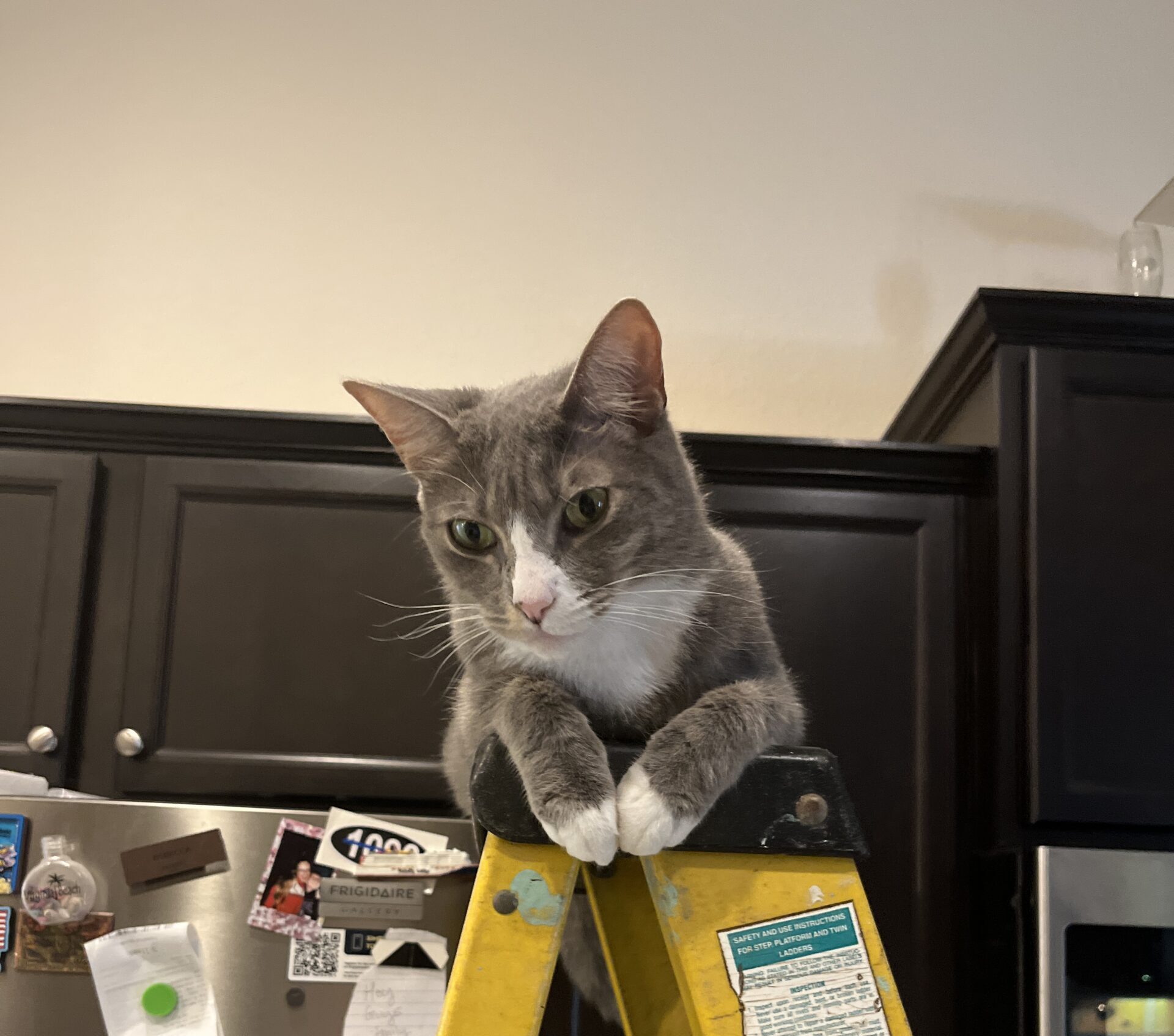
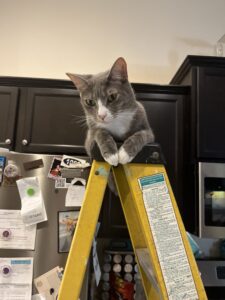
    Ladders are another favorite. Smokey loves climbing them and will vigorously defend his position once he reaches the top. He does not appreciate being told to get down. In fact, he considers such requests rude and beneath his station.

    Smokey, a grey and white cat, on top of a step ladder

    See those black cabinets in the background of the ladder photo?

    Smokey likes to jump from the counter directly to the top of the cabinets. He doesn’t bother with intermediate steps. The refrigerator is for amateurs. His parkour skills have evolved beyond such limitations.

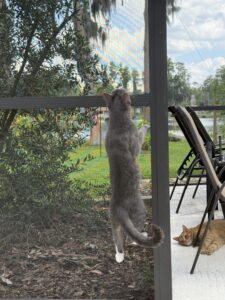
    When we moved recently, Smokey discovered a new opportunity for vertical superiority. The small tree outside our patio attracts dozens of birds and squirrels every day. Naturally, Smokey believes he should be taller than them, too.

    While he is never allowed fully outdoors, supervised patio time is one of the highlights of his day. Given the opportunity, he’ll climb the screens, stretch himself to impossible lengths, and attempt to achieve maximum altitude while maintaining visual contact with every bird in the county.

    Smokey, a grey and white cat, climbing the screen of the patio.

    We suspect Smokey’s life philosophy is simple:

    If you’re not the tallest creature in the room, are you even trying?

  • Ten Cats, 180 Claws

    Ten Cats, 180 Claws

    Our Approach to Living With Claws

    If you’re looking for the short answer, here it is:

    We don’t declaw our cats, and we don’t recommend routine declawing.

    That’s not because our cats are perfect. They are absolutely not perfect.

    These are animals who sprint through the house at 3 a.m., climb things they shouldn’t, and occasionally make questionable decisions about their climbing skills. One of them has decided that door frames are an acceptable scratching surface. (Looking at you, Pie.)

    Even with ten cats, declawing has never been something we’ve considered as a routine solution.

    What Declawing Actually Is

    Many people think of declawing as the feline equivalent of trimming nails.

    It isn’t.

    Declawing (onychectomy) is a surgical procedure that removes the claw and the last bone of each affected toe. Imagine chopping off your fingers at the first knuckle. Ow! The ASPCA opposes routine declawing and states that it should only be considered after alternatives have been exhausted or in situations where it is medically necessary for the cat.

    In other words, this isn’t a manicure. It’s a significant surgical procedure.

    Claws Are Part of the Deal

    Let’s address the obvious elephant—or perhaps the obvious murder mitten—in the room.

    This website is called Claws & Disorder, not Clawless & Disorder.

    Cats come with claws. Those claws are important tools for climbing, stretching, balance, scratching, and defending themselves if they ever find themselves in trouble.

    The reality is that murder mittens are part of cat ownership.

    While our cats are indoor cats, accidents happen. Doors get left open. Screens fail. Cats make questionable life choices. If one of our cats ever found themselves outside, we’d want them to have every advantage possible.

    We also enjoy the fact that our screens occasionally resemble a feline version of American Ninja Warrior. It’s chaos, but at least they’re equipped for it.

    Living With Claws Isn’t Nearly As Hard As People Think

    Here’s the thing: we have ten cats.

    If anyone should be living in a shredded-furniture wasteland, it should probably be us.

    Instead, we have very few scratching-related problems.

    The key is giving cats appropriate places to scratch.

    Provide Good Scratching Posts

    A surprising number of scratching posts sold in stores are too short, too flimsy, or not the right materials.

    Cats want to stretch their entire bodies when they scratch. If the post wobbles, tips over, or doesn’t allow a full stretch, many cats will simply ignore it.

    Look for scratching posts that are:

    • Tall enough for a full-body stretch
    • Heavy and stable
    • Located where your cats already spend time
    • Available in different materials and textures

    Some cats love sisal. Some prefer cardboard. Others appear committed to conducting extensive scientific research on every texture in the house before making a decision. Not all cats will use the same items. Sometimes, it’s the rug at the back door. Sometimes it’s a door frame (Pie!).

    Offering variety helps.

    We have scratching posts, cardboard scratchers, cat trees, and a variety of approved scratching surfaces throughout the house. Our cats like them at different heights and angles. Some are flat on the floor. Some stand up. Others are at an angle. Most of our cats use them exactly as intended.

    Most.

    Pie would like the record to reflect that door frames are also excellent scratching surfaces. We disagree.

    Those Little Nail Sheaths Are a Good Sign

    Ever find tiny, hollow claw coverings on the floor?

    Those aren’t broken claws.

    They’re the outer layers of the nail being shed naturally.

    If you’re never finding them, your cat may not be getting enough effective scratching opportunities.

    Scratching isn’t just about sharpening claws. It’s one of the ways cats maintain healthy nails.

    Nail Trims Don’t Have To Be Dramatic

    Despite what social media would have you believe, nail trimming doesn’t always require protective equipment, heavy sedation, and a hostage negotiator.

    Many of our cats sleep right through it.

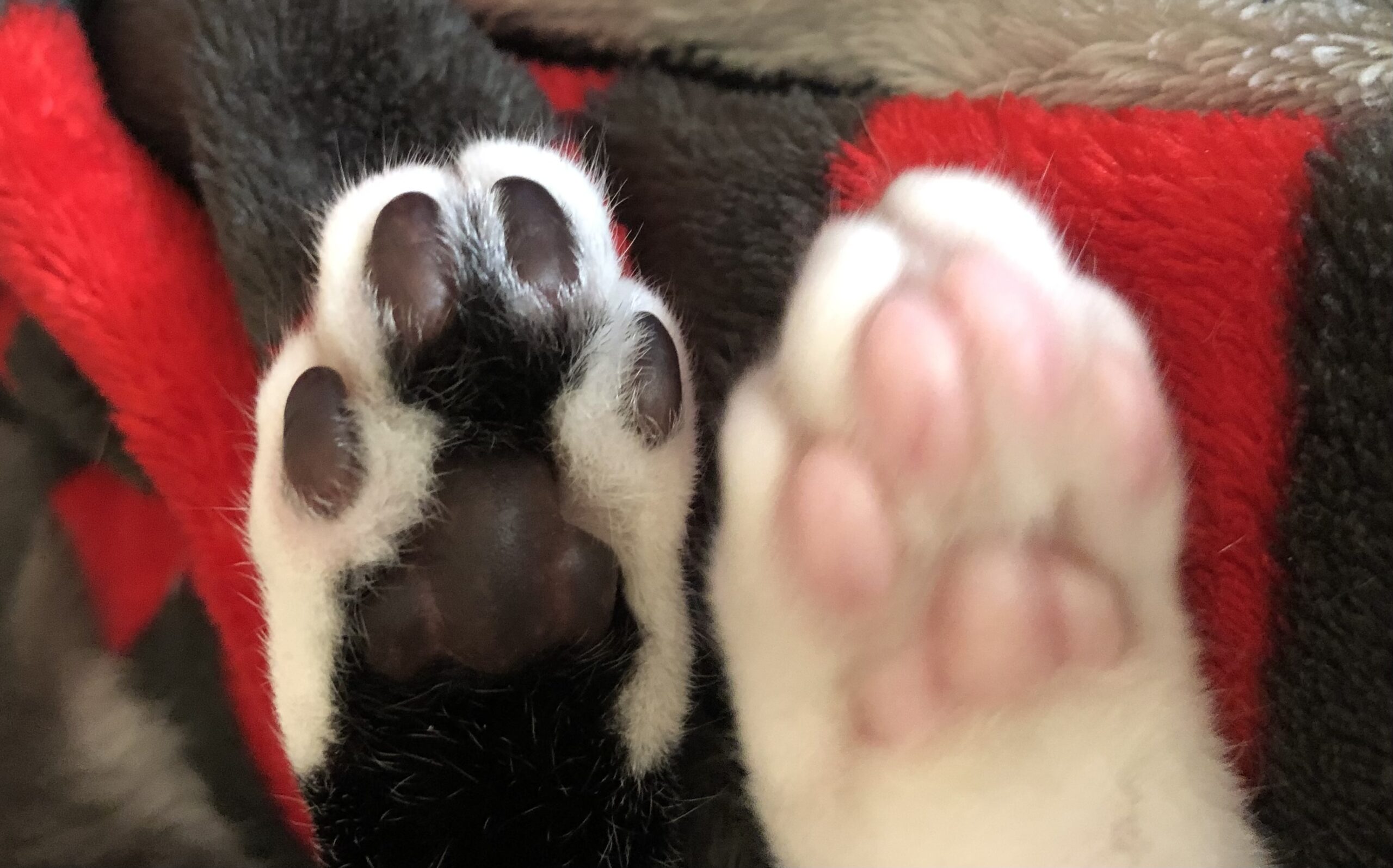
    The secret is starting early and making paw handling normal. Spend time touching those little toe beans, gently pressing their toes, and helping them learn that having their feet handled isn’t a big deal.

    One rule of thumb in our house:

    If you can hear your cat’s nails clicking across the floor, it’s probably time for a trim.

    We keep nail clippers in pretty much every room Mom spends time in. You never know when a cat is going to stretch out nearby, fall asleep, and accidentally volunteer for a manicure.

    Most of the time we don’t trim every nail in one sitting. That’s okay.

    A few nails today and a few more tomorrow is often easier than trying to wrestle a cat through a complete pawdicure.

    We focus primarily on the front claws, which seem to need trimming more frequently than the back claws. Whether the back claws wear down more naturally or simply grow more slowly remains one of the great unsolved mysteries of cat ownership.

    When trimming:

    • Clip only the sharp tip
    • Remove small amounts at a time
    • Avoid the pink quick inside the nail
    • Stop if either you or the cat becomes stressed

    A successful nail trim doesn’t have to be perfect. It just has to happen regularly.

    Are There Ever Valid Reasons To Declaw?

    Yes.

    There are legitimate medical situations where a veterinarian may recommend declawing for the cat’s health, safety, or treatment of a specific injury or condition.

    Those decisions should be made with your veterinarian based on the individual cat and their medical needs.

    What we oppose—and what many animal welfare organizations oppose—is routine declawing performed simply because a cat scratches.

    Scratching is normal cat behavior. The solution is usually management, training, appropriate scratching surfaces, and routine nail care—not surgery.

    The Claws & Disorder Verdict

    We share our home with ten cats and over 150 claws.

    The furniture is still standing.

    The humans are mostly intact.

    The cats get to stretch, climb, scratch, and engage in all of the normal cat behaviors that make them cats.

    For us, that’s the goal.

    Good scratching posts, regular nail trims, a little patience, and an acceptance that murder mittens are part of the package solve the overwhelming majority of claw-related problems.

    Cats come with claws.

    In our opinion, the better solution is teaching them where to use those claws—not taking them away.
  • The Official House Rules of Claws & Disorder

    The Official House Rules of Claws & Disorder

    As Explained by Cleo

    Have you ever watched NCIS and seen Gibbs’ rules?

    Well, apparently our cats have rules too.

    And unlike Gibbs, they enforce them loudly.

    Rule #1: The house belongs to the cats.

    • When any rule is in doubt, refer to this rule.
    • We are not homeowners. We are support staff with a mortgage.

    Rule #2: Closed doors that are not made of glass are prohibited.

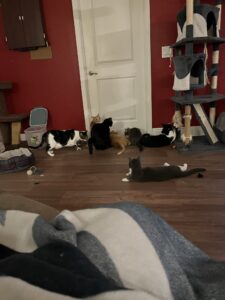
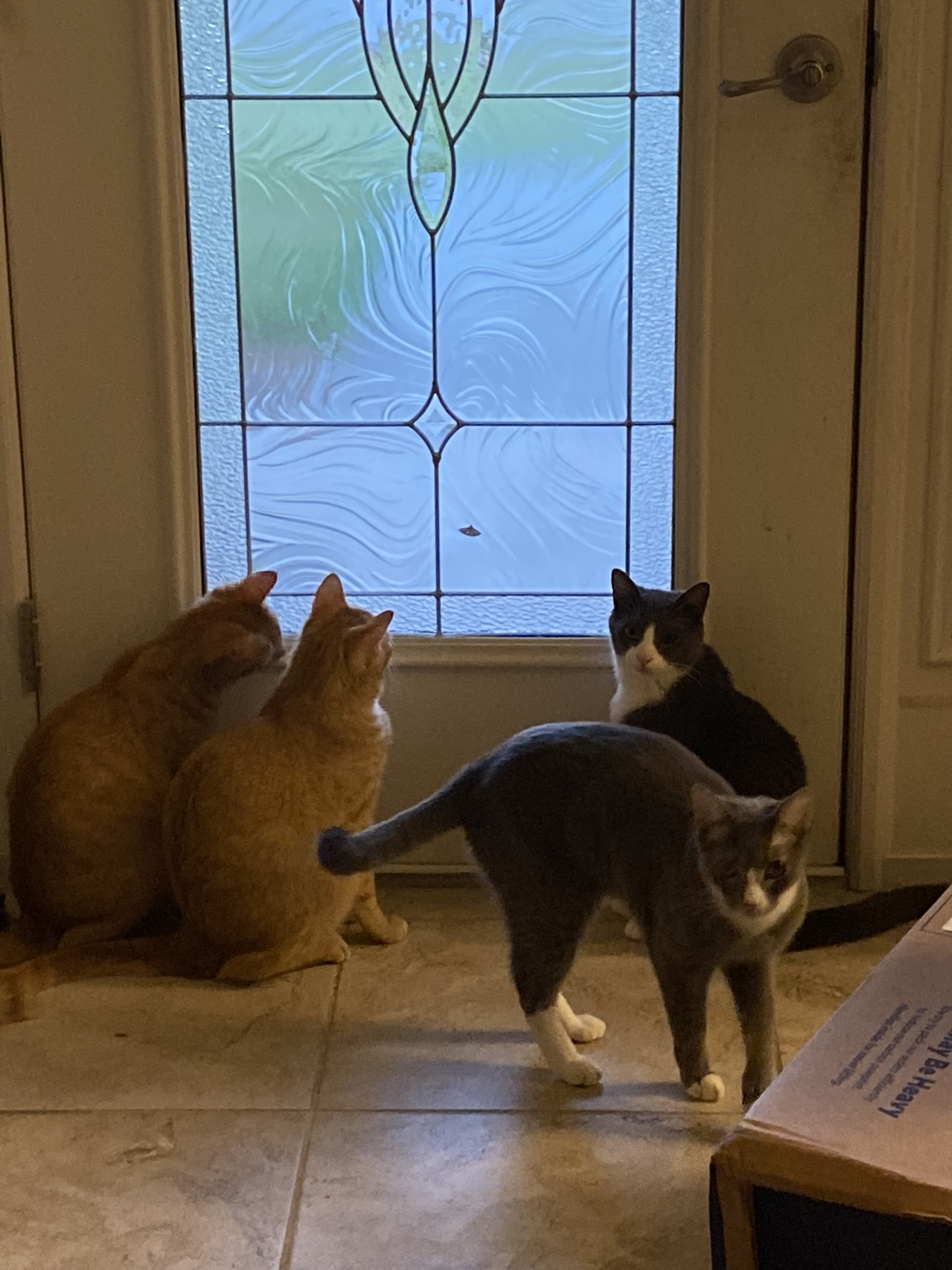
    A collection of cats in front of a closed door.

    The cats do not believe in privacy.

    Violations will immediately result in one or more of the following:

    • Pumpkin or Pie screaming dramatically from opposite sides of the door.
    • Tiny murder mittens pawing at or under the door.
    • Figaro suddenly deciding he urgently needs to be on the other side of the door.

    Once the door is opened, however, Figaro will often forget why he wanted through it in the first place.

    Rule #3: Closed doors made of glass are also prohibited.

    The transparency does not improve the situation.

    • Figaro finds glass barriers emotionally devastating.
    • Sliding glass doors and shower doors are considered deeply offensive.
    • Mournful crying will continue until the barrier is removed.

    You have been warned.

    Rule #4: If it might be food, it will be investigated.

    Bug takes food safety very seriously.

    • He always knows when someone is eating.
    • He always knows where the food is located.
    • He would like to formally inspect your ice cream.

    This inspection is not optional.

    Rule #5: Electronics may not be used when a cat requires attention.

    Cats believe screens exist solely to interfere with petting.

    • Cat paws work surprisingly well on touchscreens.
    • Laptops become significantly less functional with a cat standing on the keyboard.
    • Failure to provide adequate attention may result in hand swipes, aggressive headbutts, or a cat physically inserting themselves between you and the screen.

    Rule #6: Mom and Dad must be chaperoned at all times.

    The cats believe unsupervised human interaction is suspicious.

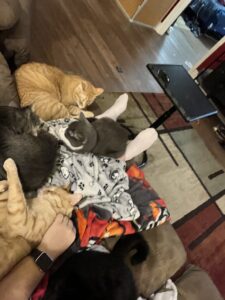
    • Romeo will position himself directly between Mom and Dad on the couch.
    • Callie lies across Dad’s chest at bedtime to prevent unauthorized rolling toward Mom.
    • Comet immediately claims his “prince pillow” beside Mom and pins at least one arm in place to restrict movement.

    The chaperone policy is strictly enforced.

    Rule #7: Sleeping cats may not be moved.

    If a cat chooses you as a bed, you are legally required to remain in place until further notice.

    • Shifting position is strongly discouraged.
    • Disturbing the cat may result in judgment, complaints, or immediate abandonment.
    • “Purralysis” can only be cured when the cat decides the cuddle session has concluded.

    Human discomfort is not considered relevant.

    Rule #8: “Kitty glitter” is a glamorous accessory.

    The cats work tirelessly to ensure their fur is included in every aspect of your life.

    • Sticky rollers are merely a temporary suggestion.
    • Black clothing is considered a personal challenge.
    • Cat hair will somehow appear on brand new clothes before they even enter the house.

    Resistance is futile. Acceptance is easier.

    Rule #9: Any visible portion of the food bowl means the bowl is empty.

    If even a single section of the bottom of the bowl is visible, the cats are clearly starving.

    • This remains true even when multiple full bowls are sitting directly beside it.
    • Food touching the edges instead of the center is apparently unacceptable.
    • Failure to immediately refill the bowl will be treated as evidence that the cats are unloved and abandoned.

    Complaints will be filed loudly and without delay.

    Rule #10: Visitors are expected to like cats.

    This is the cats’ house. Visitors are merely temporary guests.

    • Anyone claiming to “not be a cat person” will immediately be assigned a cat.
    • Allergies will be addressed through exposure therapy, antihistamines, or acceptance.
    • If someone in the house is uncomfortable, the visitors are the ones expected to leave.

    The cats live here. Everyone else is on probation.

    Including us.

    We may pay the mortgage and buy the food, but our role is clear.

    We are their servants.

    This is their house.

    They allow us to live here.

  • How We Ended Up With 10 Cats: Part 2

    How We Ended Up With 10 Cats: Part 2

    The Delusion of Stability

    Over the course of 12 months, we “accidentally” acquired six cats through a series of conscious choices, Cat Distribution System designations, and deeply questionable decisions. You can read the full story of the six cats in How We Ended Up With 10 Cats: Part 1. With humans in the house outnumbered by cats, we were confident we were done.

    We were wrong.

    The Missing Calico

    Humans: 4 Cats: 8

    My husband grew up with a calico cat that he adored. He mentioned multiple times throughout our cat adoption adventures that he wanted another calico. We did not find one. Cleopatra was close but wasn’t what he pictured. He accepted that we weren’t going to find a calico cat.

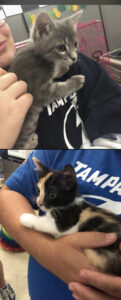
    One fateful day before a Tampa Bay Lightning hockey game, we stopped at a local mall to do some shopping. While wandering in the mall, I happened across an adoption event for kittens. A small calico kitten was staring at me through the window. She was adorable.

    So was her brother.

    A grey tabby and calico cat being held at an adoption event.

    These two kittens were the only kittens in the shop.

    Exhibiting a severe lack of judgment, I texted a picture of the kitten to my husband.

    That was my downfall.

    Once my husband picked her up, she curled up on his chest and started purring. As though she had found her home. At that stage, there was no doubt Callie was coming home. And if Callie was coming home, Thunder was coming too.

    As I mentioned earlier, we were on our way to a game. No cats allowed.

    We paid the adoption fees and arranged to pick them up the next morning.

    So, we’ve officially transitioned into “Crazy Cat Lady” territory now, according to my vet. And we’ve got eight cats.

    Eight.

    We’re done. There is absolutely NO reason to get additional cats.

    Where is Juliet?

    Humans: 4 Cats: 10

    We held strong at eight cats. We stayed there for over a year.

    We had finally achieved a fragile equilibrium.

    Then, one October day in 2021, one of my daughter’s friends came over for the first time. And asked Romeo where his Juliet was.

    My husband heard this.

    The next thing I know, we’re all loaded into the car and heading to a pet store adoption event to look at kittens. Romeo needs a white cat named Juliet. A yin and yang kind of thing.

    The first store didn’t have kittens. I took this as a sign from the universe that we should go home.

    My husband took it as a sign that he should open his phone and locate more kittens. 

    I was driving, so I’m partially responsible. He, however, was navigating and actively seeking out events, so he has to share the responsibility.

    Two tiny orange kittens sitting on a black office chair.

    We found a beautiful, partially white kitten. And two orange kittens. My daughter fell in love with an orange kitten. And we were doomed. Again, I can’t leave one kitten alone.

    Another family at the event was interested in the white kitten, so Juliet had a potential home. But if we took one orange kitten, his brother was coming too. These kittens were named by the foster-owner as Cheddar and Colby – but the kids didn’t like the names. So Pie and Pumpkin (it was Halloween, after all), came home.

    And that, Reader, brings us to 10.  Ten.

    10 cats. 180 claws. 0 common sense.

    Reader? Do you see the problem?

    We still don’t have Juliet.

  • How We Ended Up With 10 Cats: Part 1

    How We Ended Up With 10 Cats: Part 1

    History

    Growing up, there were always cats in my house. At least one. Sometimes more. Early in my marriage, the hubby and I had two cats. Then came kids. Years later, as the cats and kids got older, I assumed I’d eventually have more help with the litter boxes.  At one point, I taped money to the handle of the cat litter scoop – in a bag, of course, because Ew!  A month later, that bag was still there.  At that point, I said once the cats died, we wouldn’t be getting more.

    And I stuck to it.

    For a while. 

    The first (two) cats  – Sandy and Minerva

    Humans: 4 Cats: 2

    Eventually, the husband and kids wore me down, and I agreed to get a cat. So off to the shelter we went. In May, or maybe June, of 2018, we brought home not one, but two cats. Sandy and Minerva were adorable, playful kittens. The girls loved them. Everyone pitched in. We were happy. Stable. Responsible adults with two kids and two cats and no plans for more.

    The Cat Distribution System – Romeo 

    Humans: 4 Cats: 3

    So naturally, the cat distribution system struck just about one year later. During a rainstorm one summer day, I went out through my garage to get something from my van, parked outside. When I opened the garage, I heard a strange sound. A quiet cry. At first, I thought one of the cats, a little over a year old now, had followed me into the garage. But they hadn’t.  Instead, under my van, soaking wet and horribly skinny, was a small, reddish-brown kitten. I’d never seen this coloration on a cat before.  I yelled for my kids to bring me cat treats and lured the small baby into the garage. To avoid transmission of any illness, we kept this newcomer in a dog crate in the garage overnight, planning to turn him over to the vets office in the morning.

    The following day, the hubby and kids left for a camping trip. I took the “stray” to the vet. He was much older than I anticipated – at least 9 months old despite weighing in at less than three pounds. The vet couldn’t take him. The shelter was full. I’d have to find him a home or put him back outside. He tested clean for any communicable diseases, so I brought him inside.  That was my mistake.  Once a cat enters the house, courtesy of the CDS, there is no conceivable way to undo it.  And so, Romeo joined the crew.

    Romeo, despite being underweight and having an eye infection, wanted nothing more than to be loved. By anyone. cat or human. Didn’t matter. Unfortunately, Sandy and Minerva wanted no part of this newcomer. They weren’t mean to him, but they wouldn’t let him join in their cuddle puddle.

    A tragic loss – FIP – Minerva       

    Humans: 4 Cats: 2

    Minerva had some strange habits. One of which was sitting on the scale. Every time she accompanied you to the bathroom.  Through this habit, we noticed that she was dropping weight steadily for a few weeks and brought her to the vet.  Our primary vet strongly suspected that Minerva had Feline Infectious Peritonitis – the “wet” form, which is caused by a mutation of the corona virus.  In 2019, when this happened, there was no legally available treatment for this disease. There was a “black market” drug that might help – but it was thousands of dollars per dose and not guaranteed. 

    We sought a second opinion, hoping the diagnosis was wrong. The second vet ended up confirming the diagnosis during surgery and we decided it was better to let her pass peacefully without waking her up again and having her suffer.

    As of 2024, FIP is treatable. If you know someone impacted by FIP, make sure the vet checks the Merck Veterinary Manual.

    The house felt wrong afterward. Too quiet. Even Romeo seemed to notice.

    Romeo’s emotional support kittens 

    Humans: 4 Cats: 6

    After the loss of Minerva, Sandy adopted the dog as her snuggle-buddy.  The dog was very receptive to it. Unfortunately, this still left Romeo alone. Hubby and I talked and decided we could get another cat for Romeo to snuggle with.

    At this stage, my daughters — six years apart and professional arguers — couldn’t agree on anything. I came up with what I believed to be a brilliant plan. I’d take each of the girls to the shelter separately and let them each pick out one kitten to bring home.  Then Romeo would have a selection and maybe Sandy would make a friend of her own species.

    My brilliant plan was a great parenting decision. It was not a great pet-acquisition decision. It was at this shelter visit that I learned that I’m incapable of bringing home only one cat at a time, even if I know that another is already planned.  Cleopatra and Figaro were housed together at the shelter – and bringing home just one would have left one sad, lonely kitten in a cage. I. Can’t. Have. That.

    So, I brought home two kittens.

    Now reader, let me remind you: I left one child at home while doing this. One child picked out two kittens.  Are you seeing my dilemma?

    I had to be fair to the second child. So, back to the shelter we went.  We walked in with our own cat carrier to transport the newest selection(s) home. When we got there, the shelter staff laughed and offered me a volume discount. After some time in the “cat room”, two more kittens – both variations of grey – were selected to join the chaos.

    And just like that, our number of cats tripled in a single day.

    At this point, we had six cats.

    Surely, this was the end of the story.

    Reader, it absolutely was not.